For the passengers aboard Aloha Airlines Flight 243, the flight was supposed to be an ordinary trip between two Hawaiian islands.
Then, at 24,000 feet, the roof disappeared.
There was no warning that could prepare the people inside for what happened next. A violent rush of air tore through the cabin. Debris flew everywhere. And a huge section of the Boeing 737's upper fuselage separated from the aircraft.
Flight attendant Clarabelle “C.B.” Lansing was standing near the fifth row when the decompression occurred.
She was swept out of the aircraft and lost forever. Her story is as tragic as that of Hilda Yolanda Mayol, a waitress who survived the 9/11 attacks only to die on flight 587 two months later.
Lansing, 58, was the only person aboard Flight 243 who died as a result of the accident. Her body was never found. The National Transportation Safety Board's investigation determined that about 18 feet of the aircraft's upper cabin skin and structure had separated during the flight.
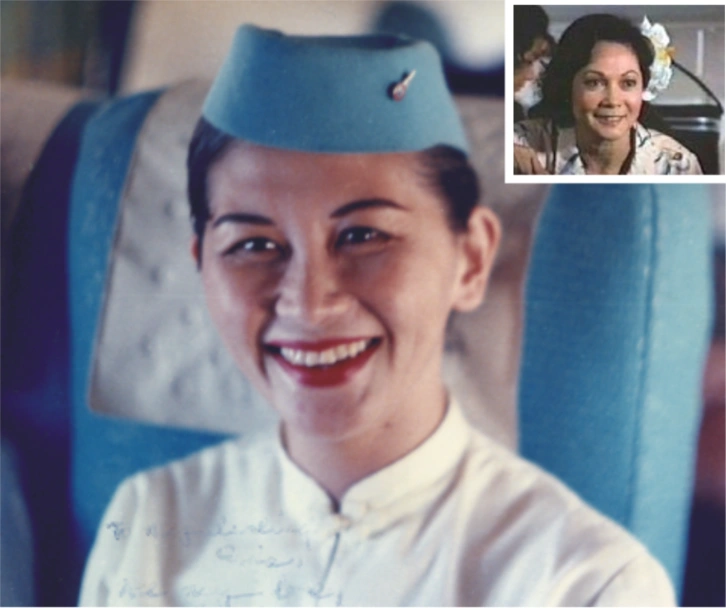
But Lansing's story is more than the story of how she died. She had spent 37 years as an Aloha Airlines flight attendant. And she was remembered by colleagues and passengers as a familiar face who knew many of the airline's regular travelers by name.
Clarabelle Lansing Was Working Flight 243 When the Roof Tore Open
Aloha Airlines Flight 243 left Hilo International Airport on April 28, 1988. It was bound for Honolulu.
The Boeing 737-200 had already completed several interisland flights that day without incident. There was nothing about the departure that suggested the flight would become one of the most extraordinary survival stories in aviation history.
Lansing was the chief flight attendant. She was working alongside Jane Sato-Tomita and Michelle Honda.
In the cockpit were Captain Robert Schornstheimer and First Officer Madeline Tompkins. Tompkins was flying the aircraft when the accident occurred.
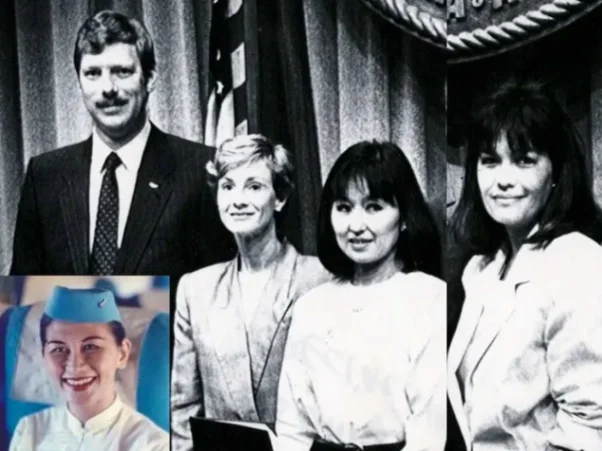
The crew of Aloha Airlines Flight 243, from left to right: Captain Bob Schornstheimer, First Officer Mimi Tompkins, flight attendants Jane Sato-Tomita and Michelle Honda. Bottom left: flight attendant Clarabelle Lansing, the only victim.
The first part of the flight was routine. Passengers settled into their seats while the cabin crew began their service.
Then the aircraft reached approximately 24,000 feet.
Tompkins heard a sudden loud “whoosh.” Schornstheimer felt the aircraft roll from side to side.
Almost immediately, the cockpit door was gone.
Schornstheimer turned around and saw something that would have been almost impossible to comprehend from inside an airplane: blue sky where the ceiling of the forward cabin had been.
“It was like a surreal experience, because I was looking through the doorway and at the bloodied faces of the passengers,” Schornstheimer told The Maui News, adding: “And the top (of the plane) was missing, from the aft of the galley to the forward edge of the wings.”
The NTSB later determined that approximately 18 feet of the upper fuselage had separated from the aircraft. The structural failure occurred while the aircraft was cruising at 24,000 feet between Hilo and Honolulu.
For Lansing, the decompression was immediately catastrophic.
Passenger accounts reported that Lansing had been standing near the fifth-row seats when the opening formed on the left side of the fuselage. The sudden loss of the aircraft's upper structure and explosive decompression swept her from the cabin.
A passenger sitting nearby later recalled the moment Lansing disappeared.
“She was just handing my wife a drink,” William Flanigan told The Washington Post, adding that Lansing had stopped and told them this was the last call and that they were going to be descending. "And then, whoosh! She was gone. Their hands just touched when it happened.”
Lansing was never seen again.
A three-day search involving aircraft and vessels failed to locate her remains.
The FAA's account of the accident similarly records that the 18-foot section of upper fuselage separated from the aircraft and that a flight attendant was swept overboard during the decompression.
Passengers and Crew Were Left Inside an Airplane With Its Roof Missing
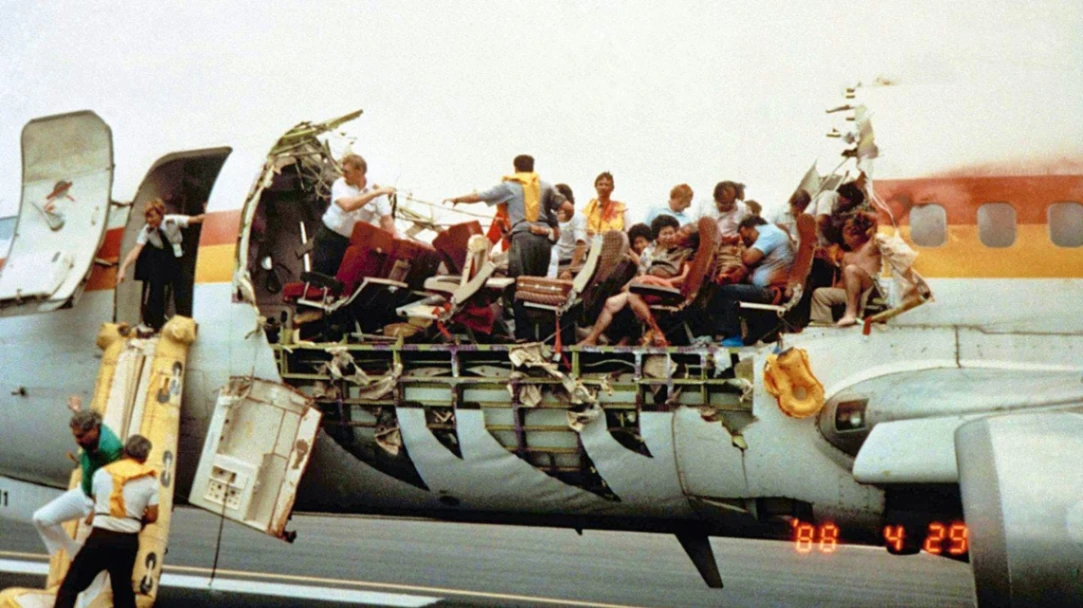
The Aloha Airlines Boeing 737-200 after landing in Maui in April 1988.
Lansing was not the only member of the cabin crew caught in the sudden violence.
Sato-Tomita was struck in the head by debris and knocked unconscious.
Honda was thrown to the floor. She managed to hold onto the metal bars beneath the seats as passengers tried to keep her from being blown across the cabin.
Eventually, Honda began moving up the aisle.
The conditions inside the aircraft were chaotic. Wind was roaring through the enormous opening. Debris was moving through the cabin. And communication between the cockpit and cabin had been cut off.
Honda tried to contact the cockpit but could not get through.
She nevertheless began helping passengers with their life vests.
In the cockpit, Schornstheimer and Tompkins were fighting to keep the damaged aircraft under control.
The structural failure had caused serious damage beyond the missing section of fuselage. The aircraft was rolling from side to side. And the pilots were faced with a problem they had never expected to encounter.
The immediate priority was not figuring out how to restore the cabin.
It was getting the airplane back on the ground.
Schornstheimer later described the mindset that took over during the emergency:
“I was just totally focused on having to make it,” he told Maui News, adding that he didn't have time to dwell on what would happen if he didn't.
The pilots began an emergency descent toward Maui.
They did not know the full extent of the structural damage. They could not see everything that had happened inside the cabin. And the roaring wind made communication difficult.
At 1:48 p.m., Tompkins managed to contact the Kahului Airport tower.
“We're just to the east of Makena,” Tompkins told the tower in a steady voice, according to Maui News. “We are unpressurized. Declaring an emergency," Tompkins added.
The crew requested emergency equipment and assistance for the landing.
The aircraft was damaged badly enough that the pilots were uncertain whether the nose landing gear would deploy properly.
They also faced another problem: slowing the aircraft had caused it to shake more violently.
“We couldn't have gone around and had the tower check our nose gear,” Schornstheimer told the outlet, adding: “We had to land. There wasn't any question about it.”
The airplane approached Kahului Airport at approximately 170 knots.
From the ground, the sight was almost unbelievable.
Miller, an Aloha Airlines station manager who watched the aircraft approach, later recalled:
“It looked like it was going to crash... There was part of it missing. The whole top of the fuselage was gone. . . . I didn't possibly think that this plane could land," he told Maui News.
But the damaged Boeing 737 made it to the runway.
At 1:58 p.m., Flight 243 landed at Kahului Airport.
The aircraft had survived the flight.
So had almost everyone aboard.
But one person was missing.
The Search for Clarabelle Lansing Lasted Three Days
Once the aircraft stopped, emergency crews moved toward the passengers and injured crew members.
A makeshift triage area was established beside the airplane.
Miller was among those trying to establish whether everyone had survived.
“We were trying to verify the headcount,” he told the outlet, noting that they “came up one short.”
Honda realized that the missing person was Lansing.
The coordinates of the accident were given to the U.S. Coast Guard, and a search began for the missing flight attendant.
The Coast Guard cutter USCGC Cape Corwin participated in a three-day search, joined by aircraft, helicopters and other vessels.
But the searchers found no trace of Lansing.
Her body was never recovered.
The official accident investigation records Lansing as the single fatality. Seven passengers and one flight attendant suffered serious injuries, while other passengers sustained minor injuries.
The condition of the aircraft after landing showed just how close the flight had come to catastrophe.
Workers had to support part of the airplane while it was being towed from the runway. Miller later described walking through the damaged aircraft.
“It felt like I was walking on a giant sponge with a cardboard floor, because you could feel all the wires and everything underneath,” Miller said, per Maui News.
He described the remaining structure as being held together by “floor beams and the man upstairs.”
For the passengers who survived, the physical damage was only part of what they had experienced.
For Lansing's colleagues, there was another painful reality: they had landed safely, but their chief flight attendant was not coming back.
Lansing Had Spent 37 Years as an Aloha Airlines Flight Attendant
By the time she boarded Flight 243, Clarabelle “C.B.” Lansing had already spent most of her adult life working for Aloha Airlines.
She was a 37-year veteran of the airline.
People who knew her remembered her not simply as an employee. But as someone who had developed relationships with the people who flew Aloha regularly.
Miller remembered her as a particularly recognizable figure among the airline's longtime passengers.
“Clarabelle Lansing was the nicest old-timer there that knew her customers, her regulars,” Miller said. “She called them by first name. She called me by first name. That was something to me. She was total Aloha customer service. She was the textbook model of a good stewardess.”
There was also something distinctive about Lansing's appearance.
“And,” Miller recalled, “She always had a garden of flowers in her hair, not one or two.”
Schornstheimer had flown with Lansing many times. They were not particularly close, but he knew that she had formed friendships with longtime Aloha passengers.
“Her life was the airline,” Schornstheimer said.
He also remembered Lansing as a strict flight attendant who emphasized that members of the cabin crew should return to their stations after completing their duties.
That detail became especially poignant after the accident.
Honda later told The Washington Post that Lansing's adherence to those procedures may have helped save Honda's life.
Lansing's story therefore became intertwined with two very different images: the veteran flight attendant who took her responsibilities seriously and the woman who was suddenly lost when the aircraft's structure failed around her.
Lansing's Story Was Later Portrayed in Miracle Landing
Eventually, the story of Flight 243 reached television.
In 1990, CBS aired Miracle Landing, a made-for-television drama based on the Aloha Airlines Flight 243 accident. The film dramatized the events surrounding the decompression and the crew's attempt to land the damaged aircraft at Kahului.
Actress Nancy Kwan portrayed Clarabelle “C.B.” Lansing in the film. Contemporary cast listings identify Kwan specifically as Lansing, alongside Wayne Rogers as Robert Schornstheimer, Connie Sellecca as Madeline “Mimi” Tompkins and Ana Alicia as Michelle Honda.
The film gave audiences another way to encounter the extraordinary story. But the real Lansing was more than the character portrayed on screen.
According to genealogical information from WikiTree, Lansing was the daughter of Henry Sau Hen Ho and Kam Kim. The site lists Lansing's children status as "unknown". Her Find a Grave memorial lists her age at death as 58 and her burial status as “Buried or Lost at Sea.”
Those details add another dimension to a story that is often remembered primarily for the aircraft's missing roof.
Lansing was a daughter, a wife and a longtime flight attendant who had spent 37 years serving passengers before that final flight.
On April 28, 1988, she disappeared from the cabin of a Boeing 737 at 24,000 feet.
Her remains were never recovered.
But the passengers who survived remembered her, her colleagues remembered her, and the accident that took her life became part of aviation history.
More than three decades later, the name Clarabelle “C.B.” Lansing remains attached to one of the most extraordinary aircraft structural failures ever investigated by the NTSB—and to the flight attendant who was lost when Flight 243 suddenly opened to the sky.