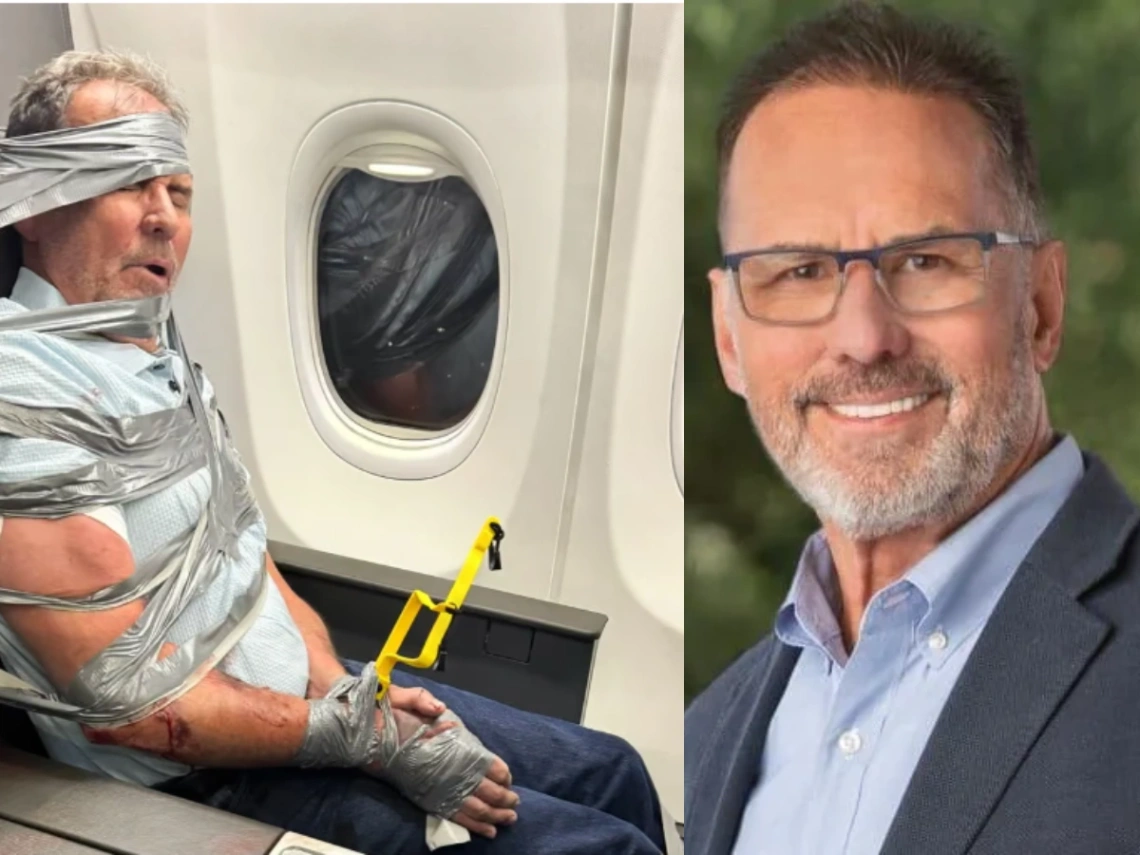
When I first saw the picture of a 67-year-old man duct-taped to his first-class seat on an American Airlines flight, my first reaction was not, “What an unruly passenger.”
It was:
How on earth did it get to this point?
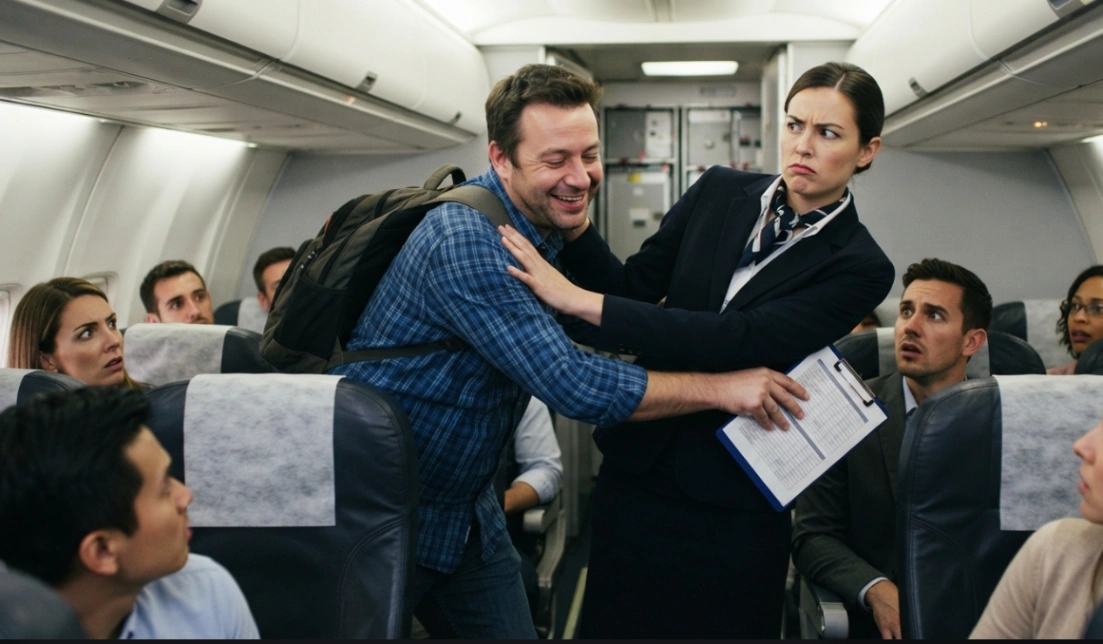
This was not a passenger being told to sit down. It was not someone arguing with a flight attendant over a drink. We are talking about a man whose hands were reportedly secured with zip ties and whose body was held to his seat with duct tape while the aircraft was diverted to Baltimore.
And that, to me, is the real story.
Layne Lundeen was flying American Airlines Flight 618 from Dallas to Newark on September 3 when, according to witnesses, his behavior became increasingly aggressive. Witnesses described profanity, racial slurs and physical aggression toward people on board. Two passengers, Richard O'Lenick and Juan Mejia, eventually helped restrain him, and the flight was diverted to Baltimore, where police arrested him on charges including second-degree assault and disorderly conduct.
I want to be careful here because Lundeen has not been convicted of those allegations.
And there is another strange part of this story: Lundeen later told a court that he did not remember what happened. He said he had consumed two drinks but did not remember the incident.
"I don’t remember any of what happened," Lundeen said in a court hearing the next day. "I assaulted a police officer? Is that what it says? I don’t have my glasses," he said after being read his charges, adding: "Oh my god, what a mess … I don’t remember any of it," per The Guardian.
I have no way of knowing whether that is genuine memory loss, intoxication-related memory loss, or something else.
But I do know this: not remembering something does not make the consequences disappear.
I don't think the duct tape is the most shocking part
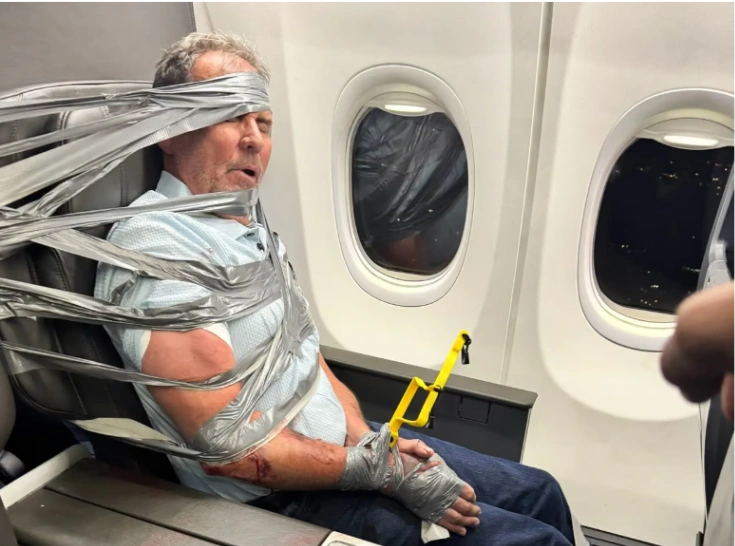
The picture is obviously what caught everyone's attention.
But honestly, I think the duct tape is almost beside the point.
What bothers me more is that ordinary people on an airplane apparently found themselves in a situation where they had to physically restrain another passenger until law enforcement could take over.
I can understand why they did it.
According to Richard O'Lenick, Lundeen continued fighting while they were trying to restrain him and allegedly bit Mejia. O'Lenick said they were trying to prevent him from hurting other people.
If I were sitting on that plane and genuinely believed another passenger was about to hurt somebody, I would want someone to intervene too.
I just don't love the idea of passengers having to become the emergency security team.
That feels like the bigger problem.
Maybe we need to talk about restraint equipment
One commenter online asked a question I actually found interesting:
"As often as this sort of thing happens, I can’t figure out why they don’t have some kind of restraint kit onboard all flights for purpose. They make single-use zip-cuffs for wrists and ankles that would take up next to no space. Duck-tape works, but that doesn’t look like it was easy to apply, and it’s certainly not ideal for the task."
I understand the logic.
If someone becomes violent in an airplane, having purpose-designed restraint equipment sounds much more sensible than searching for whatever happens to be available in the cabin.
But I also think there is a huge difference between having equipment and knowing exactly when and how to use it.
A restraint applied incorrectly can create its own safety problems. And I would not want flight attendants or passengers improvising restraint techniques unless the situation genuinely demanded it.
The FAA has extensive rules and guidance surrounding aircraft safety equipment and flight-attendant systems, but that does not mean every aircraft simply carries a universal “unruly passenger kit” for cabin crew to use whenever somebody becomes difficult.
So I don't have a neat answer here.
I just know I would rather see a properly designed procedure than a roll of duct tape becoming the final answer.
And what about air marshals?
Another commenter asked something I have wondered myself:
"Remember when there was talk of 'air marshals' - undercover cops or whatever riding on planes to keep people safe? Did those get phased out?"
Another commenter answered: "No phase out. There are definitely undercover officers and marshals on flights. If you happen to be on that random flight or high risk/high profile trip, you would see the Marshalls typically only intervene in accordance with their mission. For example, taking down a terrorist attempting a hijacking. Generally, people like me, you, and dangerous individuals they're looking for won't know who they are. How they move. But, they could be close by or sitting next to you. Giving off the impression they're not doing anything but they're around and trained to always be alert paying attention."
So, no. Federal Air Marshals are still very much a thing.
The TSA describes the Federal Air Marshal Service as part of its law-enforcement arm and says Federal Air Marshals are deployed to assess, address and mitigate potential risks and threats to transportation. The agency's roadmap also identifies an in-flight security mission as a core part of their work.
But I would not assume that an air marshal was—or should have been—on Flight 618.
And even if one was there, I would not expect that person to immediately announce themselves and start wrestling with every unruly passenger. Their job is broader than being an undercover bouncer for commercial flights.
That is actually what makes the idea fascinating to me.
There may be trained federal law-enforcement officers somewhere on a plane, and the people sitting around you generally have no idea who they are.
The passengers on this flight certainly did not have the luxury of knowing whether additional security was nearby.
So they dealt with what was directly in front of them.
I also don't want to turn the passengers into superheroes
It is tempting to watch the video and celebrate the people who restrained Lundeen.
And I understand why.
But I would still be careful about encouraging ordinary passengers to physically intervene whenever they see somebody behaving badly.
There is a huge difference between a passenger being obnoxious and a passenger becoming violent.
If someone is simply loud, I want the crew to handle it.
If someone is threatening people or physically attacking somebody, that's different.
In this case, the people who intervened were reportedly dealing with a physical situation, and one of them was a former law-enforcement officer. That is very different from a random group of passengers deciding, “Let's tackle this guy because he's annoying.”
I don't want duct tape to become the new answer to bad manners.
First class is still an airplane
There is another detail about this story that I find strangely revealing.
Lundeen was sitting in first class.
And yet none of that mattered once the situation became serious.
I actually like that lesson.
You can buy the biggest seat on the aircraft. You can order better food.
You can board first. You can have more legroom.
But you do not get a separate set of rules.
The moment your behavior starts putting other people at risk, your first-class ticket does not create a private bubble around you.
You are still on an aircraft with hundreds of other people who simply want to get where they are going safely. As the FAA put it, "dangerous behavior doesn't fly."
My biggest takeaway
I don't know exactly what happened inside Flight 618. And neither should anyone who wasn't there.
Lundeen's account is different from the accounts of the passengers who said they saw him become aggressive. The criminal case will have to sort through those details.
I, however, keep coming back to that photograph.
A grown man is strapped to an airplane seat with duct tape.
For me, that is not funny.
It is not something I want normalized.
It is a picture of the moment when a situation has gone so far out of control that a commercial airplane, its crew and its passengers have run out of ordinary options.
And that is what I hope people take away from this story.
Don't be the reason an airplane reaches that point.
You don't have to be perfectly behaved. You don't have to like every passenger. You don't even have to be in a good mood.
Just keep your behavior under control.
Because once other passengers are discussing zip ties and duct tape, the flight has already gone much too far.