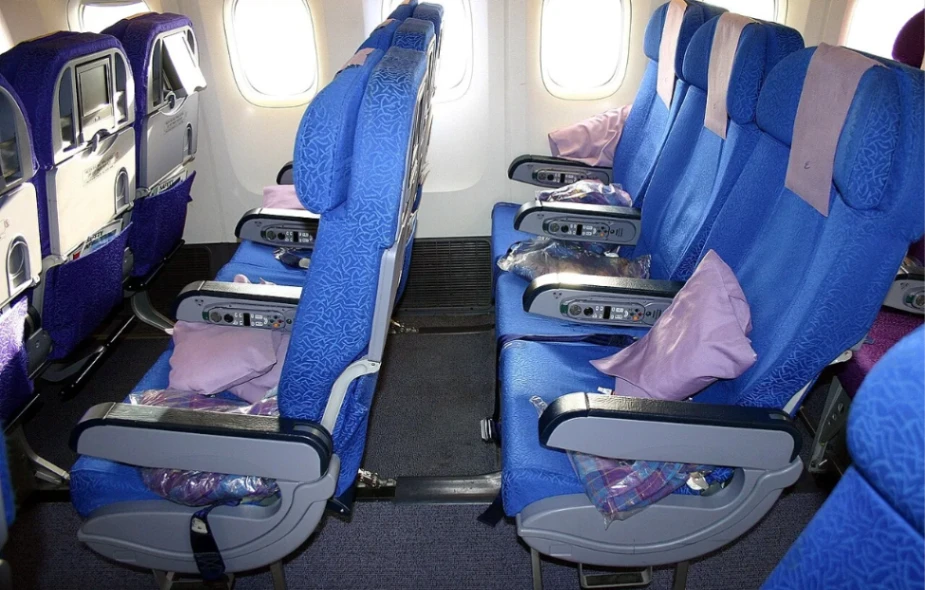

This Facebook post caught my eye immediately: "I always wanted to be a flight attendant, but I was way too short and chubby to be one."
It is a common heartbreak shared by thousands of hopeful applicants who believe the golden age of aviation—the era of the uniform weigh-ins and rigid aesthetic profiling—never actually ended. But here is the truth: Yes, a chubby, plus-size, or short person can absolutely be a flight attendant. In fact, if your height is what is holding you back, you should read my breakdown on how you can be a flight attendant if you are short.
And if you are worried about meeting a conventional runway standard, remember that you don’t have to be pretty to be a flight attendant either.
The days of direct weight discrimination are largely gone in the West. However, entering this profession means navigating an uncompromising physical landscape where the ultimate gatekeeper is not a corporate beauty pageant, but the structural engineering of the aircraft cabin itself.
1. The Legal and Regional Reality
Your physical experience as an applicant depends entirely on where the airline is based. Western aviation focuses on "functional fitness," while other regions still tightly control crew aesthetics.
The Western Standout: Inclusive but Exact
European and North American carriers focus entirely on safety competence. An easyJet Flight Attendant on an Indeed forum captured this culture perfectly when asked if the airline would consider hiring an overweight person:
"Yes, easyJet welcomes everyone, it doesn't matter if you're tall or short, big or small, blue, green, or black eyes, blond or brown hair, it doesn't matter your nationality. Everybody is welcome to the orange family and they make you feel part of the orange family."
The International Divide: The Battle of the BMI
Contrast this with Middle Eastern or Asian legacy carriers, which openly enforce weight metrics. On a recent aviation forum, an applicant asked:
"Emirates BMI- I’m a 28 in the overweight category, is this bad ? I don’t look big but do look like I carry a little bit of excess weight." A user realistically replied:
"I’d recommend you to apply if you don’t look overly overweight in person. if you end up being rejected before reaching the final interview, it’s completely fine, you can learn from it and get better for next time, it probably won’t be related to your BMI, but if you do reach the final stage and you are told to lose some weight to get onboard, then just lose some weight and try to meet their standards. I wish you the best in your journey, hopefully you can get the job."
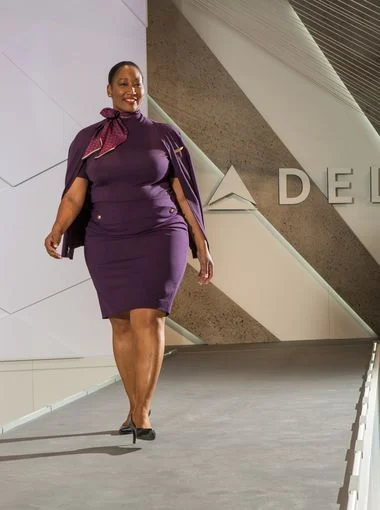
This photo from a Delta Air Lines event shows a plus-size flight attendant commanding the runway with immense poise and presence. It proves that modern Western legacy carriers select for authority and professional presentation over tiny waistlines.
2. The Non-Negotiable Official Airline Requirements
If you apply to a Western carrier, you will face rigorous physical performance tests (PPTs) designed to ensure you can act as a first responder in an emergency. The official job descriptions from major airlines highlight exactly what your body must be capable of doing.
United Airlines
United explicitly outlines the intense physical workload required in the cabin:
"Ability to stand, walk, kneel, bend, stoop, stretch, reach, lift heavy objects (such as luggage to overhead bin or window exit) and push and pull beverage cart (up to 250 lbs)," the airlines says, adding: "Ability to pass a functional reach assessment with a combined 76-inch vertical and 43.5- inch horizontal reach and hold (simultaneous), without shoes on, in order to reach and operate all necessary equipment, machinery, and doors."

This official employee group profile from United Airlines showcases genuine corporate inclusion. The diverse lineup features a healthy, realistic spectrum of body types, including a plus-size woman on the right. It is living proof that if you have the physical strength to manage the cabin. You belong in the uniform.
Alaska Airlines and Hawaiian Airlines
For these carriers, the vertical reach requirement is even more demanding, independent of weight:
"Reach 82 vertical inches while standing on toes but without wearing shoes - approximately 5’2” in height. Comfortable being in a swimming pool with a life vest during emergency training and in water during an inflight emergency. Alaska Airlines and Hawaiian Airlines provide between 6 - 8 weeks of intensive training programs for each class of flight attendants. After training, flight attendants are equipped to fight fires, save lives and take on any obstacle. Trainees also spend time in the air working alongside current flight attendants for on-the-job experience."
3. The Engineering Bottlenecks: Aisle Widths & Safety Exits
Even if an airline does not directly discriminate against weight, aircraft dimensions are unforgiving. A flight attendant online summarized the practical realities of the job:
"You need to be able to move about the cabin easily, handle carts, luggage, and fit through the escape doors and windows. It requires lots of walking, lifting, bending, and reaching. You also have to repeat emergency aircraft procedures (escape over wings and down emergency slides) at least every 18 months in recurrent training and be able to fit comfortably in a jump seat next to another flight attendant. As long as you’re healthy and fit enough, they can’t legally disqualify you for being a little overweight as long as your appearance and personality fit the company’s image."
Because of these rules, the specific aircraft your airline flies will completely alter your daily physical experience.
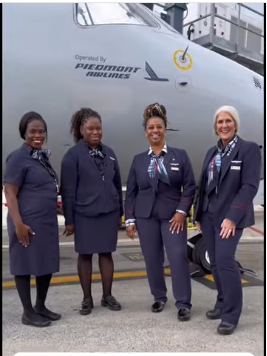
This real-world example features a Piedmont Airlines crew standing on the tarmac. Regional flying utilizes smaller, narrower jets where space is highly restricted. Yet, this diverse crew proves that plus-size flight attendants aren't just limited to massive widebody planes—they successfully navigate the tightest cabins every single day.
Single-Aisle Dynamics: Airbus A320 vs. Boeing 737
Airbus single-aisle cabins generally provide a wider aisle and more interior room than comparable Boeing narrowbody aircraft.
Dimension Metric | Airbus A320 Family | Boeing 737 Family | The Impact for Plus-Size Crew |
|---|---|---|---|
Cabin Width | ~146 inches (3.70 m) | ~139 inches (3.54 m) | Airbus provides 7 more total inches of cabin space. |
Aisle Width | 19 to 20 inches | 18 to 19 inches | Airbus allows more room to pass carts and passengers. |
Twin-Aisle Dynamics: Airbus A350 vs. Boeing 787
The difference is equally stark on long-haul widebody aircraft. The Airbus A350 features a cabin width of approximately 220 inches, supporting comfortable nine-abreast seating with wider individual seats and spacious dual aisles.
Conversely, the Boeing 787 cabin width is approximately 215 inches—5 inches narrower. When configured in a nine-abreast layout, the 787 results in tighter shoulder room and noticeably narrower aisles than the A350.
Another experienced flight attendant shed light on how airlines use these tight dimensions as a natural filtering system during the hiring process:
"I'm currently employed for Horizon Air and I'm applying at my second airline now. I recently had an acquaintance not make it on at SWA because of her weight. Her hips touched the seatbacks when she walked down the aisle during the physical performance test (pre-employment)," the flight attendant writes, adding: "The days of directly discriminating against someone's weight are gone. But it's easy for airlines to find ways to get more ideal body shapes for the job. Delta Airlines used to require FAs to be able to fit in the L-1011 escape shaft or something of that sort which was tight even for slim shapes. Most airlines require you be able to fit through the smallest exit during training which is understandable."
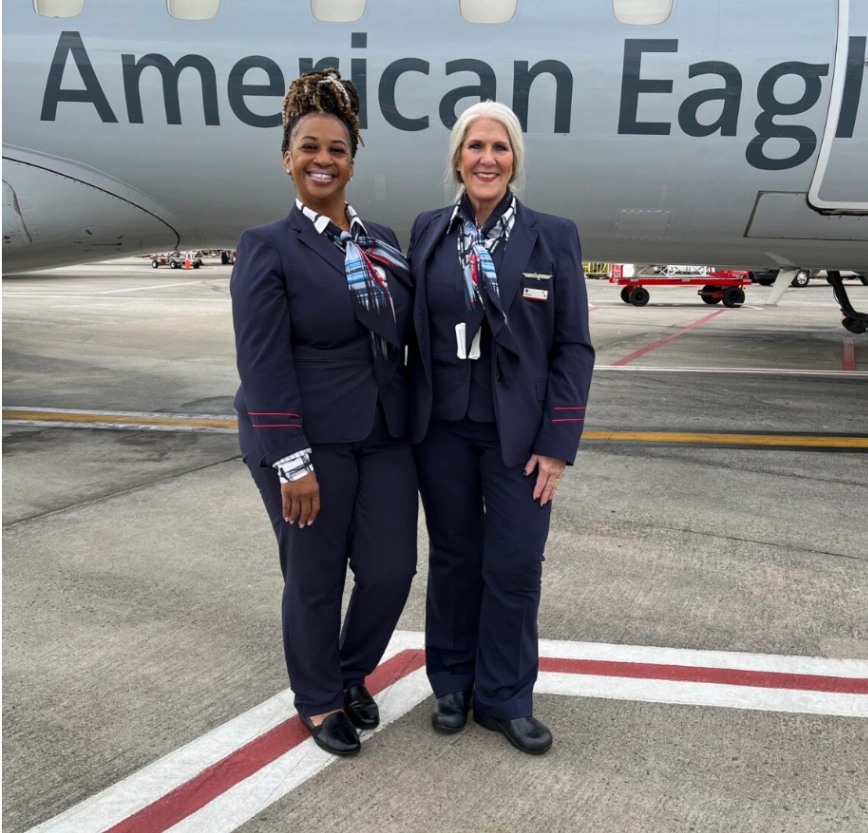
This final example shows two American Eagle (operated by Piedmont) flight attendants standing side-by-side. The professional on the left demonstrates how a properly tailored trouser uniform accommodates a fuller figure while looking incredibly sharp. In the air, your crew cares about your teamwork and warmth, not your dress size.
4. The Ultimate Requirement: Flexibility
If you can hit the vertical reach lines, fit down the narrow aisles of a Boeing 737 without brushing the seats, and securely fasten a multi-point crew jumpseat harness without an extender, your weight will not stop you from earning your wings.
The true test of a great flight attendant is not a number on a scale, but your ability to adapt to a high-stress, rapidly changing environment. As Joyce, a Piedmont flight attendant, beautifully notes: “Our trainers told us that the only thing we could depend on is change.”
Dress for the interview. Wear something professional and well-fitted. Comfortable shoes. Confident posture. You're showing them how you'd look in uniform and how you carry yourself.
If you have the stamina to manage a 250-pound cart, the agility to slide through an overwing exit, and the emotional resilience to navigate the training, the sky is wide open for you.
Frequently Asked Questions
Do airlines hire overweight flight attendants?
Yes. Most US airlines don't hire based on weight. They check whether you can pass the reach test and fit the jumpseat harness. United states there is no weight requirement.
What disqualifies you from becoming a flight attendant?
Failing the reach test or the jumpseat fit test. Not meeting the minimum age, which is 18 at many airlines and 21 at Gulf carriers. And failing the airline's background or medical checks.
Is there a weight limit for a flight attendant?
Not at most US airlines. Some Gulf carriers, like Qatar Airways and Emirates, reportedly require weight proportionate to height. Check the airline's current careers page before you apply.
Is there a chubby flight attendant?
Yes. Plus-size people work as flight attendants. They pass the same fit tests as everyone else: the reach assessment and the jumpseat harness.
Is it hard on your body to be a flight attendant?
Yes. You stand and walk for long stretches, push heavy carts and lift bags into overhead bins. Southwest lists lifting up to 20 pounds overhead, and WestJet reportedly requires lifting up to 50 pounds. Irregular schedules and time zone changes add wear on top of that.
Can I still be a flight attendant at 40?
Yes. There's no maximum age limit at most airlines, and US age discrimination law protects workers 40 and older. Minimum ages run from 18 to 21, and Delta requires 21. Some Gulf carriers accept older applicants but reportedly favor younger ones, so check the specific airline.
Does weight matter to be a flight attendant?
The number on the scale doesn't matter at most US airlines. Fit does. You need to sit in the jumpseat with the seatbelt and shoulder harness fastened, move through the aisle and pass the reach test.
Are there plus-size friendly airlines?
No airline advertises itself that way. And every one tests for fit. That said, some are clearer than others about what they check.
United: States there is no weight requirement. You must pass a reach test and sit in the jumpseat with the harness fastened.
Southwest: Lists fit requirements openly. You must fit quickly through the overwing window exit and into the jumpseat harness without an extender.
American and Delta: I found no published weight limit for either. Expect the same jumpseat fit test. Confirm on their careers pages.
Canada: WestJet reportedly requires a 204 cm barefoot reach and lists no weight limit. I couldn't find a published weight limit for Air Canada.
UK: easyJet publishes its harness measurements (106 cm across the lap and 157 cm from shoulder to waist), so you can check your fit before you apply. British Airways lists height and reach, not weight, according to crew guides.