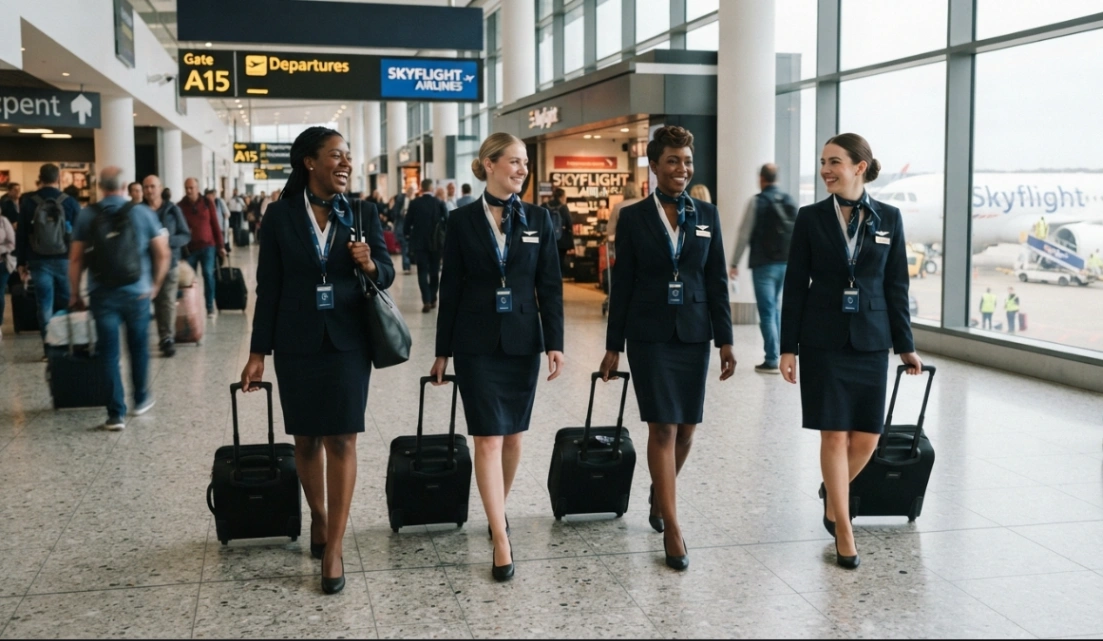
Do flight attendants have to look pretty? In other words, do you have to be conventionally beautiful or handsome to be a flight attendant? Put simply, do you have to look attractive to be a flight attendant? No, you don't.
Maybe you have looked at flight attendants and thought, “I could never do that. I'm not pretty enough.”
Maybe you have seen cabin crew with perfect smiles, flawless makeup, styled hair, and that polished airline look, and quietly decided that you do not belong in that world.
I want you to stop there for a moment.
Your face does not decide whether you are capable of becoming a flight attendant.
You do not need to be the prettiest person in the room. You do not need to look like a model. You do not need perfect features, perfect skin, or some special kind of beauty that you think airlines are searching for.
You need to be you—and present yourself well.
Airlines do care about appearance. That said, appearance in this context is much more about looking professional, clean, well-groomed, and put together than winning a beauty contest. There is a huge difference.
Think about the qualities that actually matter when you are 35,000 feet in the air.
Can you communicate with different kinds of people?
Can you stay calm under pressure?
Can you work with a team?
Can you handle an angry passenger without losing your composure? Can you take safety seriously?
Can you make someone feel comfortable when they are nervous?
Those are real skills. And unlike facial features, they are things you can develop.
So, if you have been talking yourself out of a flight attendant career because you do not think you are attractive enough, please do not make that decision for an airline before you have even applied.
Give yourself the chance.
You may not look like the flight attendant you imagined in your head. You may look completely different from the people you have seen on Instagram. That does not mean you cannot wear the uniform, walk down that aircraft aisle, and be very good at the job.
In this article, we will look at what airlines actually expect from flight attendants when it comes to appearance—and, more importantly, where the line is between looking professional and believing you have to be beautiful.
What Airlines Want
Take United Airlines, for example. On its current Flight Attendant qualifications and requirements page, United lists things such as being at least 21 years old, having a high school diploma or GED, customer-service experience, being able to speak English fluently, communicating clearly in high-stress situations, having a valid passport, meeting its physical requirements, and being legally authorized to work in the United States. United also says candidates must maintain a professional appearance and meet its grooming and uniform standards.
Notice something?
United does not say you have to be beautiful. It does not say you have to be handsome.
And I think that is worth pointing out because people sometimes imagine there is a secret beauty standard sitting somewhere on the airline's hiring checklist.
There isn't one on the list.
In fact, United's own flight attendants have stories that are much more about their dreams, careers and what they do on the job than how attractive they are. Rene B., a United International Purser since 2012, wrote:
“I still remember being a young boy growing up on a small farm in the Philippines, watching airplanes fly overhead.”
He goes on to describe how he eventually became a United flight attendant and now serves as an International Purser. His story is about turning a childhood dream into a career.
And United is not the only airline where the published requirements focus on things other than beauty.
Delta currently lists requirements such as being at least 21, having a high school diploma or GED, being legally authorized to work in the U.S., speaking, reading and writing English fluently, and being willing to work the kind of flexible schedule the job requires. Delta does have appearance requirements for the interview and emphasizes looking clean, pressed and professional. But again, that is a professional standard, not a requirement to be pretty or handsome.
American Airlines similarly emphasizes professional presentation during its flight-attendant hiring process, including grooming and dress requirements for its in-person experience. But its process is also designed to assess your qualifications, communication, judgment, and ability to perform the essential functions of the job—not whether you are beautiful or handsome.
Ryanair's published cabin-crew requirements focus on things such as English proficiency, swimming ability, flexibility, customer service, and an outgoing personality.
And WestJet's requirements include English fluency, a passport, background checks, and passing a functional physical assessment. WestJet even describes its redesigned cabin-crew uniforms as emphasizing comfort and body inclusivity.
So there is an important distinction here.
Airlines can care about how professionally you present yourself without requiring you to be beautiful.
You may be expected to have neat hair, appropriate grooming, clean clothing and a polished appearance. That makes sense for a customer-facing safety role where you represent the airline.
But being polished is something you can control.
Your face? Your nose? Your teeth? Your body shape? Whether you look like a model?
Those things are not the same as being qualified to be a flight attendant.
So, before you look at a flight attendant and think, “I could never look like that,” look at the actual requirements instead.
You may already have many of the things an airline is looking for.
Why Do People Find Flight Attendants Attractive?
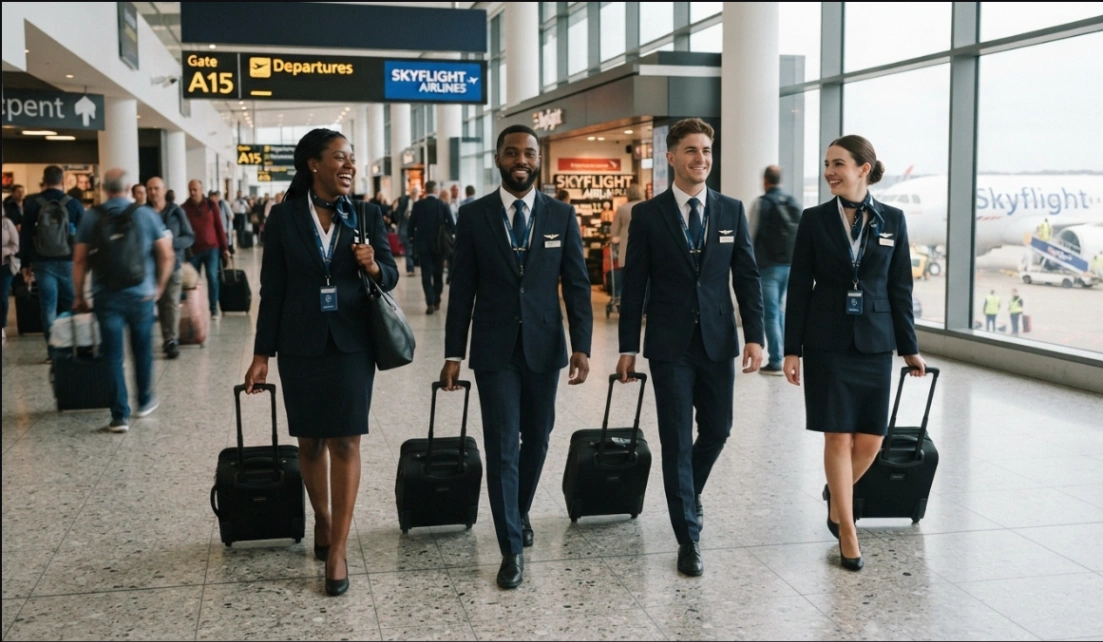
Have you ever wondered why flight attendants seem so attractive?
You are certainly not imagining that people see them that way. Some airlines have even become associated with glamorous-looking cabin crew. In a 2011 Business Travel and Meetings Show survey of 1,000 business travelers, Virgin Atlantic's cabin crew was voted the most attractive, with Singapore Airlines in second place and Emirates fourth.
But there is something important going on here.
You are not necessarily seeing natural beauty. You are seeing the finished product of professional presentation.
Think about what you see when a flight attendant walks down the aisle.
The uniform is sharp.
The hair is neat.
The makeup, where worn, is polished.
The shoes are clean.
The posture is usually good.
Everything looks coordinated.
Put all of those things together and a person can look remarkably polished.
Singapore Airlines is probably one of the best examples. Its famous cabin crew uniform, the sarong kebaya, has been part of the airline's identity since 1974, and the airline describes its cabin crew as ambassadors of its hospitality. Its training also includes grooming alongside safety, service and other professional skills.
Emirates similarly trains new cabin crew in how to wear and represent its iconic uniform, with the airline describing the goal as keeping crew members looking immaculate.
So when you look at a flight attendant and think, “Wow, they are beautiful,” you may be responding to the whole presentation rather than simply the person's natural appearance.
And this matters for you because you may be comparing yourself to that finished image.
Don't.
The woman or man you see walking through the cabin has had their hair styled, uniform fitted, grooming prepared and professional presentation put together. You are comparing yourself at home in your everyday clothes to someone at work who has been trained and prepared to look polished.
That is not the same thing as saying they were born more beautiful than you.
And perhaps the biggest clue is what today's major cabin-crew rankings actually celebrate. Skytrax's 2026 World’s Best Airline Cabin Crew ranking describes the award in terms of professionalism, hospitality, efficiency, friendliness and attitude—not physical attractiveness. Singapore Airlines placed second in that ranking.
So yes, flight attendants can look incredibly attractive.
But a large part of what you are seeing is presentation, grooming, confidence and a well-designed uniform coming together.
That is very different from needing to be naturally beautiful to become one.
Legal rules
There is a useful legal point here: being told you are “not pretty enough” is not simply a lawful hiring standard everywhere. Employment-discrimination laws protect people from discrimination based on certain personal characteristics, although the exact protections differ by country and jurisdiction.
United States: Federal law does not generally list physical attractiveness as a protected characteristic. But Washington, D.C. does. Its Human Rights Act makes it unlawful for an employer to discriminate based on “personal appearance” when hiring or in employment.
United Kingdom: The Equality Act 2010 protects nine characteristics, including “age; disability; … race; … sex; sexual orientation.” Physical attractiveness itself is not one of the listed protected characteristics.
Canada: The Canadian Human Rights Act prohibits employment discrimination on listed grounds including “race, national or ethnic origin, colour, religion, age, sex” and disability. General attractiveness is not separately listed.
New Zealand: The Human Rights Act says an employer cannot discriminate against a qualified applicant “by reason of any of the prohibited grounds of discrimination.” Those grounds include sex, race, colour, disability, age, family status and sexual orientation, but not beauty or general physical attractiveness.
Australia: Protections vary by state. Victoria is particularly relevant because its Equal Opportunity Act protects “physical features,” including height, weight, size, shape, facial features, hair and birthmarks, in employment.
So, no, you should not assume that an airline can legally demand that every flight-attendant applicant be “beautiful.” In some jurisdictions, discrimination based on particular physical features is expressly protected, while elsewhere the law protects other characteristics that may be relevant to appearance.
And there is a big difference between requiring a professional appearance and requiring a beautiful face.
Tattoo and Piercing Can Disqualify You, Though
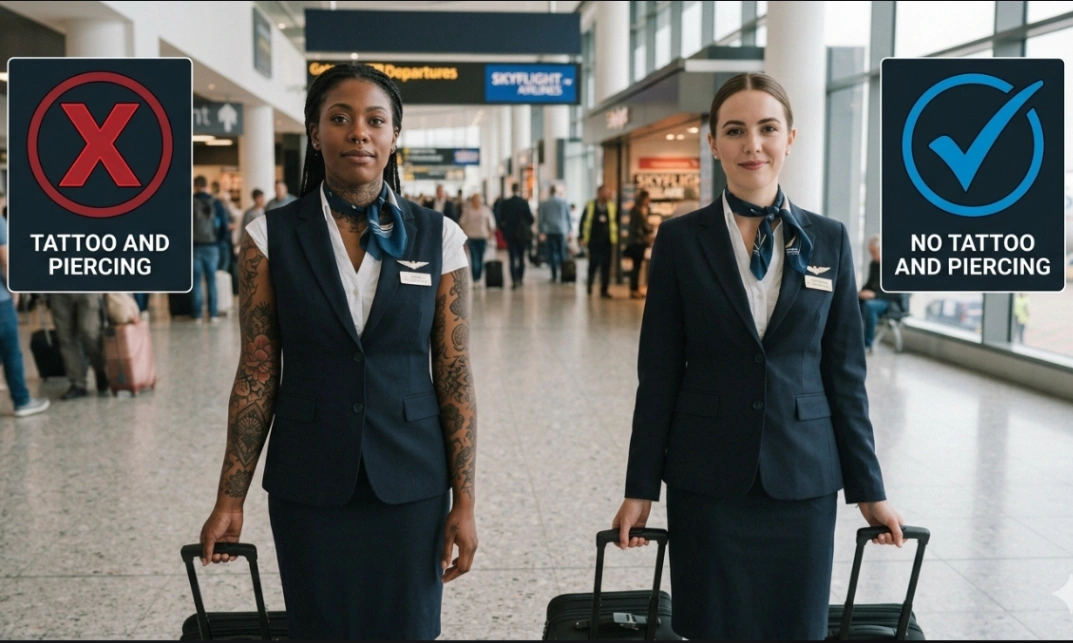
There is one part of appearance you do need to take seriously: tattoos and piercings.
Airlines have their own grooming policies, and some of them can be strict. United, for example, states:
"As a Flight Attendant at United, tattoos are NOT permitted on the head, hands, fingers, or neck, including back of your neck and on, in, or behind the ear. Those tattoos are not permitted to be covered by makeup or bandages," says the airline, adding" "...if you are in the process of getting a tattoo in any of these prohibited areas removed, they must be fully removed prior to applying for the flight attendant position."
United does allow some visible tattoos on areas such as the arms, wrists, ankles and feet, subject to size, placement and content rules.
Other airlines have their own variations. Alaska Airlines, for example, allows limited tattoos on some areas of the body but restricts visible tattoos on the face, front of the neck and chest.
So yes, a tattoo or piercing can affect your chances of becoming a flight attendant. But notice the difference: airlines are setting specific grooming and uniform rules—not asking whether you are pretty enough.
Always check the current policy of the airline you want to work for before applying.
You Can Be a Flight Attendant If You:
Meet the airline's age and education requirements.
Can communicate clearly and speak the required language fluently.
Can provide good customer service and work well with different types of people.
Can stay calm and professional when things become stressful.
Can follow safety procedures and instructions carefully.
Can work effectively as part of a team.
Can handle the physical demands of the job and meet the airline's medical or functional requirements.
Can meet the airline's grooming, uniform, tattoo and piercing rules.
Are legally allowed to work in the country where you are applying.
Are willing to work irregular hours, weekends, holidays and spend time away from home.
And look at what this list is really asking for: skills, responsibility, professionalism and the ability to work with people.
You may still have insecurities about your appearance, but don't let them make the decision for you. There is only one way to find out whether you belong in the cabin crew world: apply and give yourself the opportunity to prove what you can do.
You might be surprised by how far your personality, work ethic and confidence can take you.
And while you're preparing for the job, it is worth learning what passengers can do that makes a flight attendant's job harder. Take a look at my guide to the mistakes air travelers make, according to flight attendants so you know what to expect from the other side of the aisle.