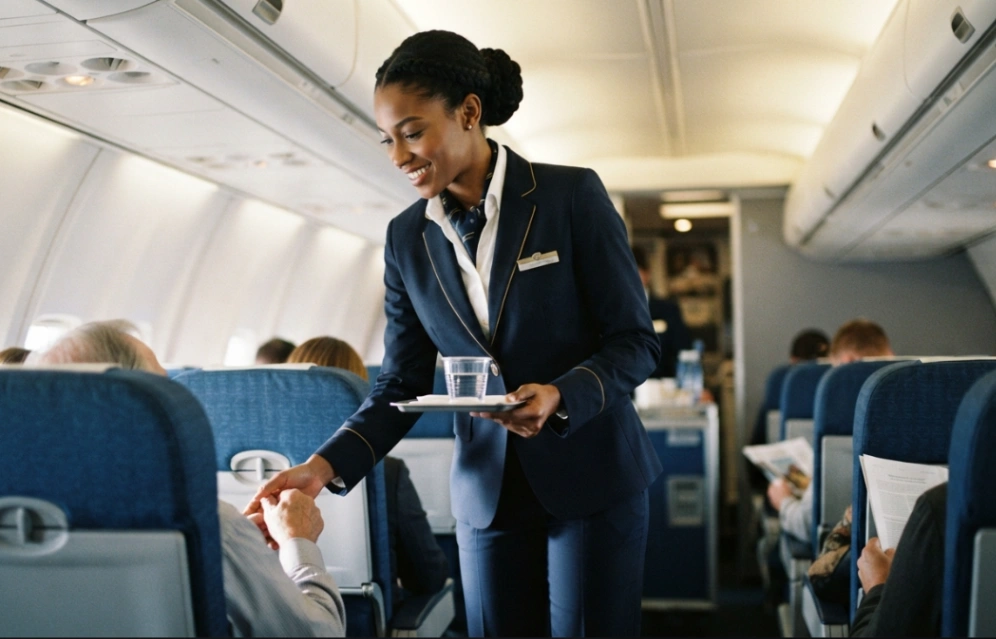
I get it. Most photos and advertisements we see online show slim flight attendants. They look polished in their uniforms, and everything about their appearance seems carefully put together. I can't blame you if you've started getting the impression that all flight attendants must be skinny.
Maybe you are a little chubby. Maybe you are plus-size. Perhaps you have looked at yourself in the mirror and wondered whether an airline would hire someone with your body type.
I want you to look at this career from a different angle.
Those advertisements are meant to attract customers. They are not universal hiring standards.
When an airline hires a flight attendant, it needs someone who can look after passengers, communicate clearly, follow safety procedures and respond to emergencies. The job has physical demands, of course, but being slim is not automatically the same as being physically capable.
Not being skinny or slim isn't one of the things that disqualify you from being a flight attendant.
Let's look at what airlines actually require, including the physical tasks you may have to perform, so you can judge your chances using facts rather than assumptions about your body.
1. What airlines actually require
I think the best place to start is with the airlines themselves.
Take United Airlines in the United States, for example. Its official flight attendant qualifications and requirements explicitly state that there is no weight requirement. However, applicants must meet the airline's functional reach requirements, be able to sit in an assigned jump seat with the seatbelt and shoulder harness fastened, and perform various physical tasks.
That distinction matters.
United does not simply ask whether you are skinny. It asks whether you can perform the work.
For example, the airline requires flight attendants to be able to:
"Ability to stand, walk, kneel, bend, stoop, stretch, reach, lift heavy objects (such as luggage to overhead bin or window exit) and push and pull beverage cart (up to 250 lbs)"
Now, think about that for a moment.
Can you push and pull a beverage cart that weighs up to 250 pounds? Can you lift objects as required by the job? Can you move around the cabin and respond when something goes wrong?
Those are much more useful questions than asking whether you weigh 60 kg, 80 kg or 100 kg.
And notice the wording: the 250-pound figure refers to the beverage cart's stated weight for pushing and pulling. United does not say you must lift 250 pounds.
Southwest Airlines says you "Must be able to lift and/or lower objects weighing up to 20 pounds, such as carry-on baggage, into/from overhead bins without assistance."
It also says you "Must be able to lift and/or lower and carry objects weighing up to 100 pounds (such as emergency life rafts) with assistance," adding that you "Must be able to reach above your head with arms fully extended to operate aircraft overhead bins and manipulate objects such as emergency equipment and luggage."
What's more, the airline says you "Must be able to bend down to the ground and assume a squatting position with knees touching the ground, in order to arm and disarm an aircraft door, to perform CPR/ First Aid, or other emergency tasks."
Physical capability and body size are not interchangeable.
2. What airlines in other countries say
United is not the only airline whose published requirements focus on the ability to perform the job. Let's look at examples from the United Kingdom, Canada, Australia and the Middle East, too.
Region | Airline and published requirements | What you should understand |
|---|---|---|
United States | United Airlines explicitly says there is no weight requirement. It lists physical duties such as lifting heavy objects and pushing or pulling a beverage cart of up to 250 pounds. | The listed standard focuses on functional ability, not a target body weight. |
United Kingdom | British Airways requires a functionality check for tasks including reaching overhead lockers and opening aircraft doors. Its stated vertical functional reach is at least 2.01 metres. | Applicants must meet the required reach and demonstrate that they can perform these tasks. |
Australia | Virgin Australia asks applicants to be able to reach a height of 180 cm. It also emphasizes customer service, safety briefings and remaining calm under pressure. | A reach requirement is not the same thing as a body-weight requirement. |
Middle East | Qatar Airways specifies a minimum arm reach of 212 cm and excellent health and physical fitness. Etihad Airways lists a minimum height of 163 cm. | Requirements differ by airline, so check each carrier's current criteria. Height, reach and physical fitness are separate from simply being skinny. |
Canada | Air Canada describes the role as being about "safety, empathy and delivering the comfort of home." Its public careers overview does not set out a general body-weight limit. | Read the specific vacancy requirements rather than assuming a slim body is compulsory. |
These examples come directly from airline career pages. They also show why I would never advise you to give up on becoming a flight attendant based only on your body shape.
I also want to be honest with you: not every airline has identical requirements, and I cannot promise that every carrier will assess candidates in the same way. You must check the requirements for the airline you want to join.
But the existence of physical standards does not automatically mean you must be slim or have a particular body shape.
3. Can you do the physical work?
This is where I want you to be honest with yourself.
A flight attendant's job involves much more than looking good in a uniform and serving drinks. Airlines have to know that their crew members can perform essential duties safely.
Virgin Atlantic, for example, describes cabin crew as needing to be physically capable of:
"pushing, pulling, lifting, reaching and manoeuvring equipment and people safely, including in emergency situations"
The airline also says crew members must be able to stand and walk unaided for extended periods, up to eight hours, while remaining alert and safety-focused. You can read these requirements on its official Cabin Crew careers page.
Now ask yourself: Can you handle prolonged standing and walking? Can you move equipment safely? Can you reach what you need to reach? Can you follow emergency procedures and respond appropriately under pressure?
These are useful questions because they focus on what you can do, rather than what you look like.
For example, a slim person may struggle with a physically demanding task, while a plus-size person may perform it comfortably. The opposite can also be true. You cannot reliably determine someone's strength, stamina or coordination from their body shape alone.
I know of a skinny lady who is dull, to say the least. I know of a chubby lady who is light as light.
I am not saying this to put either woman down. My point is that being skinny does not automatically make someone energetic, confident or capable, just as being chubby does not automatically make someone slow or incapable. A person's body shape tells you very little about their personality, work ethic or ability to care for people.
What matters is whether you can meet the actual requirements of the job.
4. Does being plus-size mean you will struggle in the uniform?
Not necessarily.
I understand why you might worry about this. You see flight attendants wearing fitted uniforms, and you wonder whether you would look right in one.
But looking professional does not mean everyone must have the same body shape.
Airlines have uniform and grooming standards, and you should review those standards before applying. The important questions are whether the airline can provide a suitable uniform in accordance with its policies and whether you can perform the job safely and meet its requirements.
You can be a flight attendant if you are a chubby or plus-size person. And, you can be a flight attendant if your are short.
That does not mean body size is irrelevant to every practical consideration. For example, United requires flight attendants to be able to sit in an assigned jump seat with the seatbelt and shoulder harness fastened. That is a specific safety requirement—not a declaration that every crew member must be slim.
If you are concerned about whether you can comfortably fit the required seat and restraint, check the airline's current standards and ask its recruitment team about the assessment.
Please do not turn that one practical question into a judgment about your worth or potential.
5. Being skinny is not a personality trait or a job qualification
I want to make another point here because I think it gets overlooked.
When we see attractive, slim people represented repeatedly in airline advertising, we can start connecting their appearance with the idea of being the ideal flight attendant.
But those are two different things.
A flight attendant needs to communicate clearly, work well with colleagues, treat passengers respectfully, stay calm under pressure and take safety seriously. A cheerful personality can help with customer service, but even the most outgoing person must learn the procedures and responsibilities of the job.
For example, Qatar Airways says it looks for people with strong interpersonal and communication skills, a genuine passion for helping people, and confidence working with different cultures. Those qualities are much more directly connected to the work than a particular body shape.
I am not saying appearance never matters to an airline. Professional presentation can matter, and individual airlines set their own uniform and grooming rules.
But professional presentation is not the same as being skinny.
And you don't have to be pretty or attractive to be a flight attendant.
6. What should you do if you are worried about your weight?
Rather than trying to guess what a recruiter thinks of your body, take these practical steps:
Read the current requirements. Check the airline's official careers page for physical assessments, reach requirements, seat and restraint requirements, and any published fitness standards.
Ask the recruitment team. If a requirement is unclear, ask directly instead of relying on rumours or social-media comments.
Prepare for the actual duties. Work on your stamina, mobility and ability to perform the tasks specified by the airline. You do not need to assume that losing weight is the answer to every concern.
Be realistic, but do not reject yourself prematurely. If you meet the stated requirements, apply and let the airline assess you.
And please be careful about crash diets or trying to change your body quickly just to look like the flight attendants you see online. The goal should be to prepare for a safety-critical job, not to chase an appearance you believe recruiters prefer.
Final thoughts
If you are reading this because you are chubby, plus-size or simply not as slim as the flight attendants you see in advertisements, I want you to remember one thing.
Your body shape does not tell the whole story about what you can do.
A short person can be a flight attendant. You can be a flight attendant if you are a chubby or plus-size person. What you need to establish is whether you meet the particular airline's requirements and can perform its duties safely.
So, instead of asking yourself, “Am I skinny enough?”, ask, “What does my chosen airline actually require, and can I meet those standards?”
That is a far more useful question—and one you can do something about.
Give yourself the chance to find out. Don't let a picture of someone else's body make the decision for you.