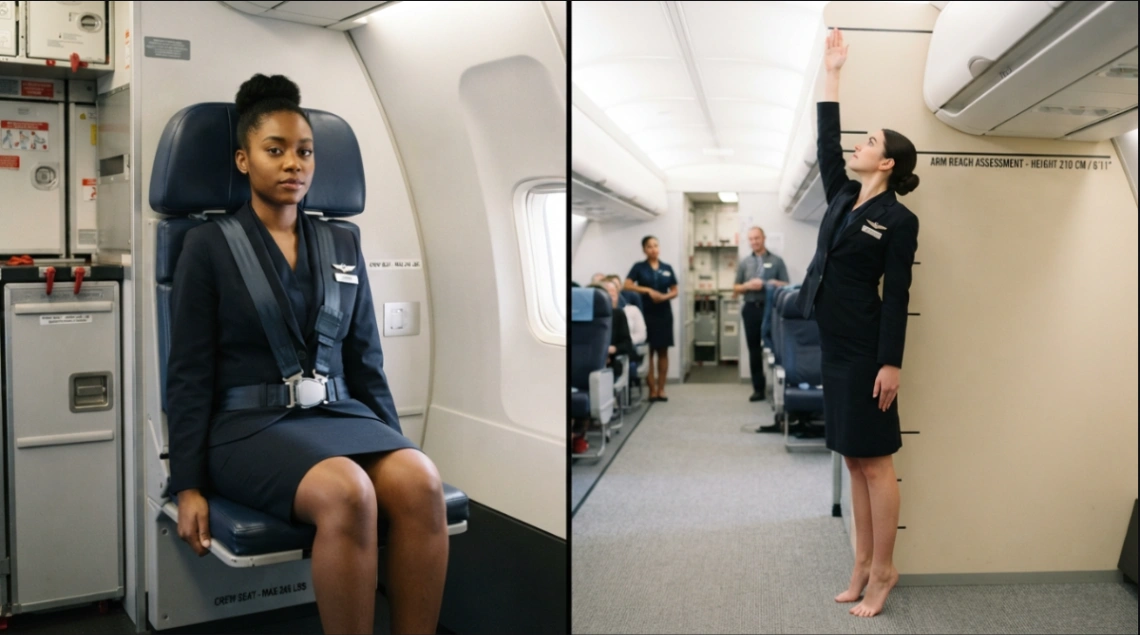
You typed the numbers into Google. 5'1". 4'11". 5'0". Then you waited for the verdict.
Here you are: most major airlines never ask for your height or your weight. They ask two other questions. Can you reach the safety equipment? Can you fit the seat and the exits? That’s it. A tape measure answers neither one.
I did say most. A few carriers do publish ranges, and I’ll show you exactly which ones so you don’t waste an application. I read airline job descriptions across the US, Canada, the UK and Australia to build this guide.
The Honest Truth: Three Types of Airlines
1. Airlines that test function, not numbers.
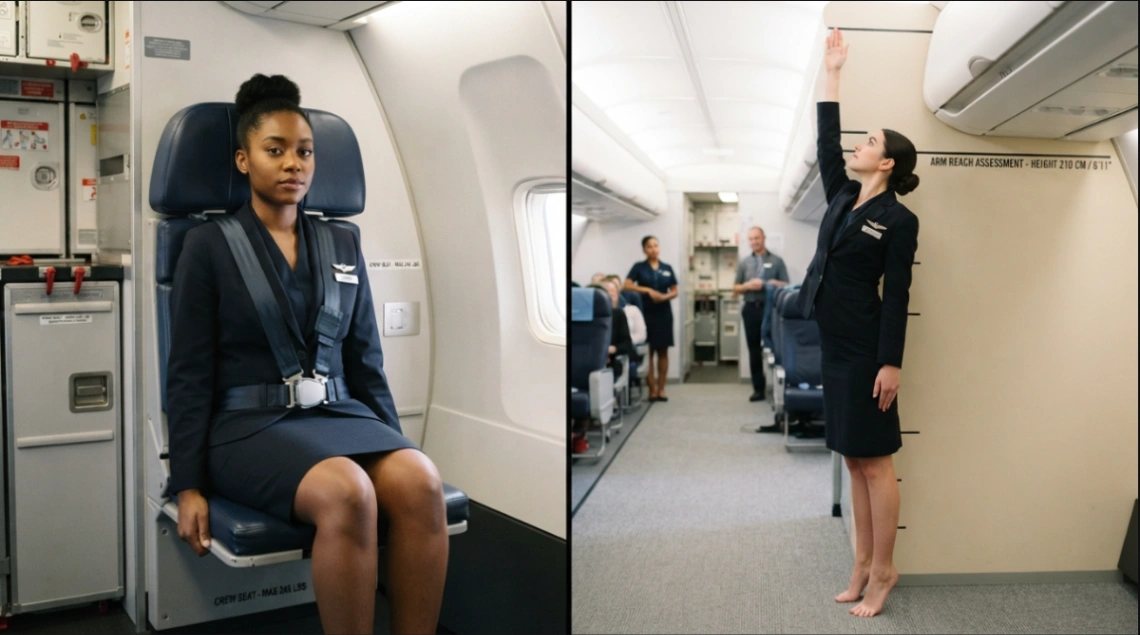
United doesn’t list a height. It requires a “functional reach assessment with a combined 76-inch vertical and 43.5-inch horizontal reach” held at the same time. And without shoes. Southwest goes further. A moderator on its careers community answered the question directly: “There is not a height or reach requirement” for its flight attendants. It does require applicants to “fit into a jumpseat harness without modification.” WestJet requires you to pass a “functional physical assessment.”
2. Airlines that set a reach number.
QantasLink lists a “Minimum reach of 212cm from the ground” (that’s 6'11.5"), with both hands, barefoot. Virgin Australia has reportedly asked crew to “reach to a height of 180cm on flat feet.” That’s 5 feet.
3. Airlines that set a height range.
SkyWest, a US regional carrier, lists 5'0" to 6'0" without shoes. Its industry briefing adds “there are no exceptions.” easyJet asks for 5'2" to 6'3" without shoes.
So the honest title for this article is: there’s no fixed requirement at most airlines. Know which kind you’re applying to.
Reach: The Test That Replaces Height
Most Airlines don’t care how tall you look. They care whether your fingertips reach the emergency equipment stored overhead.
Here’s what the airlines I checked say:
Airline | Reach standard | |
|---|---|---|
United (US) | 76 inches (193 cm) vertical and 43.5 inches (110 cm) horizontal, shoes off | |
Southwest (US) | No height or reach requirement | |
WestJet (Canada) | Functional physical assessment | |
QantasLink (Australia) | 212 cm (83.5 in), both hands, barefoot | |
Virgin Australia (Australia) | 180 cm (71 in), flat feet | |
British Airways (UK) | 1.575m |
British Airways says "you need to be of a required height, maximum of 2.01m. The airline adds that you need to "have a vertical function reach of at least 2.01m." In order to be able to meet the reach requirement, the airline says "you likely need to be at least 1.575m in height. That is 5.1 feet tall.
Three Room Tests: Can You Reach It?
You don’t need a recruiter to find out. Take your shoes off and try these:
1. The bookcase test. Most tall bookcases stand about 6 feet (72 inches). If you can touch the top flat-footed, you’re at roughly Virgin Australia’s 71 inches.
2. The door test. A standard US interior door is 80 inches tall. If your fingertips reach its top edge, you clear United’s 76 inches with 4 to spare. QantasLink’s 83.5 inches is 3.5 inches above that door.
3. The ceiling test. A standard ceiling is 96 inches. United’s 76 inches sits 20 inches below it, about the length of your forearm and hand. Qantas’s 83.5 inches sits 12.5 inches below.
If you can reach the top of a standard door, you’re tall enough to be a flight attendant at most airlines. These are rough checks. So confirm the exact number with your airline.
What Do These Numbers Mean for Your Height?
Overhead reach is roughly 1.3 times your height. That’s an estimate. Arm length can shift it by several inches. Use it to get oriented, then measure yourself.
Your height | Est. reach | United (76 in) | Virgin Australia (71 in) | Qantas (83.5 in) |
|---|---|---|---|---|
4'10" (58 in) | ~75 in | Borderline | Likely | Unlikely |
4'11" (59 in) | ~77 in | Likely | Likely | Unlikely |
5'0" (60 in) | ~78 in | Likely | Likely | Unlikely |
5'1" (61 in) | ~79 in | Likely | Likely | Borderline |
5'2" (62 in) | ~81 in | Likely | Likely | Borderline |
5'3" (63 in) | ~82 in | Likely | Likely | Likely |
Quick answers to the numbers people search:
4'11": Possibly, at airlines that test reach, like United or Southwest. Not at SkyWest or easyJet.
5'0": Yes at SkyWest (it’s their minimum) and likely at reach-test airlines. Not at easyJet.
5'1": Yes at SkyWest, United and Southwest. Not at easyJet, which sets 5'2" as the minimum.
I wrote a full guide for shorter applicants: Yes, You Can Be a Flight Attendant if You’re Short.
Fit: The Test That Replaces Weight
Weight isn’t the test. Fit is.
SkyWest states the logic plainly: “Height and weight must allow for safe operation of the aircraft.” The same posting spells out what that means:
sitting in the jumpseat and fastening the harness, moving through the aisle and operating emergency exits. SkyWest’s briefing says you must also fit quickly through the overwing exit without a seatbelt extension.
Southwest posted the same standard, and added a nuance. A careers moderator said there are no specific height or weight restrictions. But the flight attendant handbook says weight should be proportionate to height so that a neat appearance is maintained and job functions aren’t hindered.
easyJet publishes a number: a jumpseat harness measuring “106cm across the lap and 157cm from shoulder to waist.” That’s about 42 inches across the lap and 62 inches shoulder to waist.
If you’re plus-size and worried, read why plus-size applicants do become flight attendants.
Three Room Tests: Can You Fit It?
1. The harness test. Cut a string to 106 cm (about 42 inches). Wrap it around your hips over fitted clothing. If it closes with a bit to spare, that’s an encouraging first sign for a belt of that length. It’s not a guarantee. Airlines test with the real harness.
2. The window-exit test. The FAA sets overwing exits at a minimum of 20 inches wide and 36 inches high. Put two chairs 20 inches apart and step through quickly without touching either one. A standard kitchen counter is about 36 inches high, so that’s your height check.
3. The aisle test. The FAA requires aisles on larger aircraft to be at least 20 inches wide at armrest height and 15 inches near the floor. Set two boxes 20 inches apart and walk forward between them, as if pushing a cart.
If you can walk a 20-inch lane forward, step through a 20-by-36-inch opening and buckle a 42-inch belt around your hips, you pass the fit tests that matter.
A caution on fit: the harness is the one place where airlines hold firm.
SkyWest asks for fit without a seatbelt extension. And so does Southwest. And fit can be contested. In 2020, the AP reported a fired Spirit Airlines flight attendant who sued after being told to fit into a “too small” jumpseat. Her suit alleged racial discrimination. Cases like that show the standard isn’t always applied evenly.
What If I Miss by an Inch?
Don’t panic. And don’t cheat the test.
Check the airline type first. If you’re 5'1" and easyJet says 5'2", try United, Southwest or SkyWest instead.
Know the rules of the test. Shoes are off. Many airlines test both arms at once. Some allow tiptoes. Ask your recruiter.
Work on mobility, not your body. Shoulder stretches can add real reach.
Reapply. United, for example, lets rejected candidates reapply after 12 months. "My bestie got hired on her third try. Keep applying," says a flight attendant in an Instragram post.
Beyond the Tape Measure
The measurements get you through the door. What gets you hired is everything else: empathy, calm under pressure, swimming, teamwork. I covered all of it in 12 Qualities for Aspiring Flight Attendants.
And if you worry about looks, I wrote about that too: You Don’t Have to Be Pretty or Beautiful to Be a Flight Attendant.
Final Thoughts
You’ve probably been staring at a number, 5'1" or 4'11" or something else, and wondering if it’s enough.
Here’s what I’d do. Stop asking Google or generative AIs about your height. Ask the airline about its test. Grab a tape measure and find your reach. Cut a string for the harness. Walk a 20-inch lane.
Then apply to the airlines that measure function, not numbers.
The industry once chose people by their height and weight. Today, most big airlines choose people who can reach the equipment and fit the seat. And those are things you can measure at home.